Overview
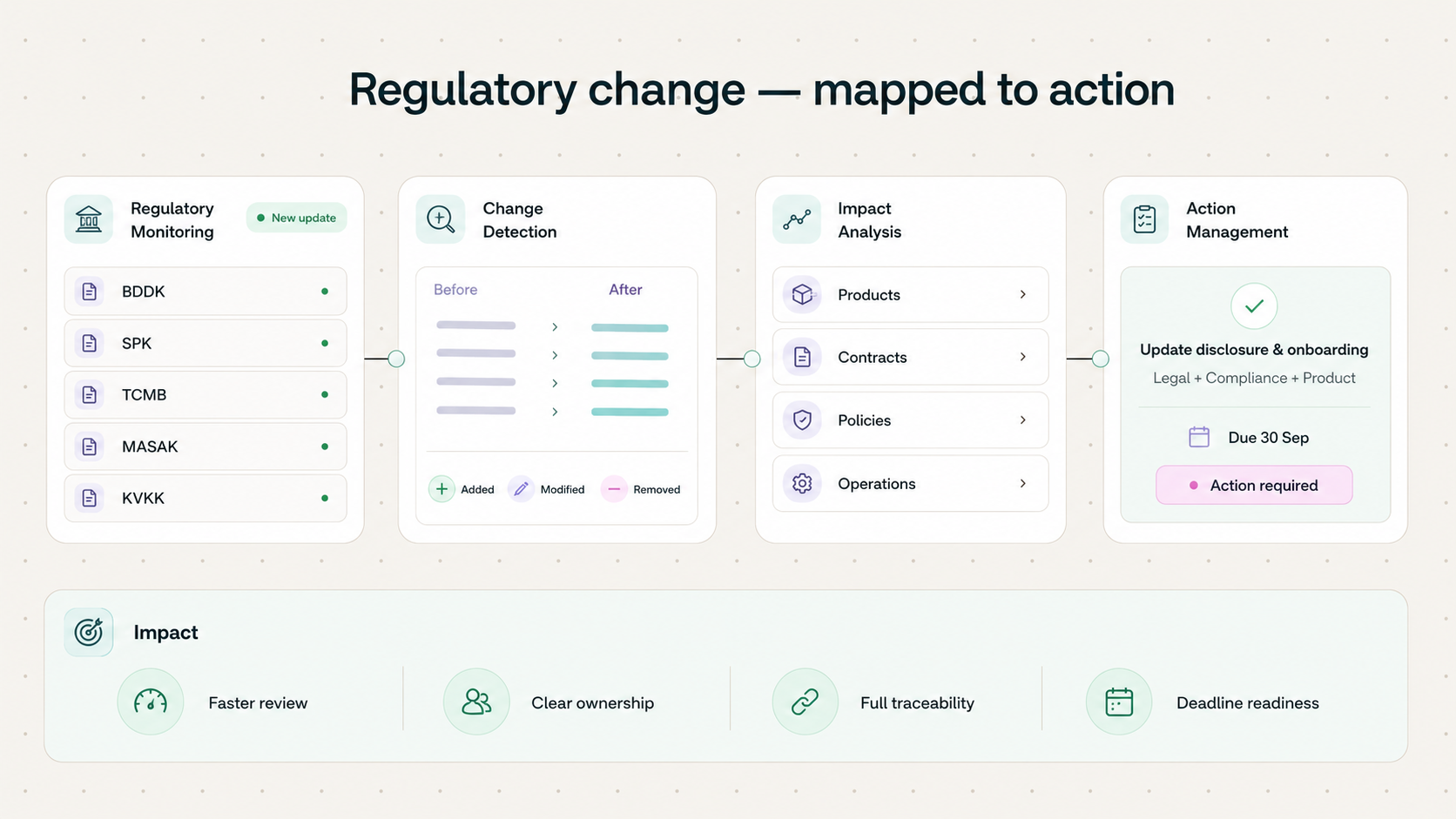
Upsonic enables banks and financial institutions to monitor regulatory updates published by authorities such as BDDK, SPK, TCMB, MASAK, and KVKK, assess how each change affects the organization, and coordinate the required actions across relevant teams.
The Agent compares newly published regulations with previous versions, identifies material changes, maps their potential impact across products, contracts, policies, and operational processes, and helps institutions track the actions required before regulatory deadlines.
Capabilities
Regulatory Monitoring:
Tracks newly published regulations, communiqués, guidelines, and amendments from relevant regulatory authorities and identifies updates that may require institutional review.
Change Detection:
Compares new regulatory texts with previous versions and highlights added, removed, or modified provisions to help teams understand exactly what has changed.
Impact Analysis:
Identifies which products, contracts, internal policies, procedures, controls, and operational processes may be affected by each regulatory change.
Action Management:
Suggests the actions required for each identified impact, recommends the responsible teams, and helps track outstanding items and approaching effective dates.
Case Study
Traditional Workflow
In a traditional financial institution, regulatory and compliance teams manually monitor publications from authorities such as BDDK, SPK, TCMB, MASAK, and KVKK.
When a new regulation or amendment is published, employees read the new text, compare it with the previous version, and determine which provisions have changed.
The compliance team then evaluates how these changes may affect the institution’s products, customer contracts, internal policies, procedures, and operational processes.
Required actions are typically communicated to legal, compliance, product, operations, IT, and other relevant teams through email, spreadsheets, meetings, or separate task management tools.
As multiple regulatory changes progress simultaneously, tracking ownership, deadlines, dependencies, and completion status becomes increasingly difficult and requires significant manual coordination.
Workflow with Upsonic
With Upsonic, newly published regulatory texts are automatically analyzed and compared with the previous applicable version.
The Agent identifies the specific provisions that have been added, removed, or modified and summarizes the material changes for the relevant compliance team.
It then evaluates the change against the institution’s internal knowledge and determines which areas may be affected, including:
- Products and services
- Customer and vendor contracts
- Internal policies and procedures
- Compliance controls
- Operational workflows
- Customer communication
- Reporting requirements
- Technology and system processes
For each identified impact, the Agent can suggest the required action and the team most likely responsible for completing it.
Regulatory Change: New disclosure requirement for a financial product
Affected Area: Customer agreement and onboarding process
Required Action: Update the relevant contractual clause and onboarding disclosure
Responsible Teams: Legal + Compliance + Product
Effective Date: 30 September
Status: Action Required
The Agent keeps the regulatory change, affected internal areas, required actions, responsible teams, and deadlines connected within the same workflow.
As the effective date approaches, incomplete actions can be surfaced for review, helping compliance teams identify which requirements still require attention before the regulation becomes applicable.
Impact
Upsonic reduces the manual effort required to compare regulatory texts, determine organizational impact, and coordinate follow-up actions across multiple teams.
By connecting regulatory changes directly to affected products, contracts, policies, and processes, the Agent helps institutions move from simply monitoring regulation to actively managing its implementation.
Compliance teams gain a centralized view of what changed, why it matters, who needs to act, and which actions remain incomplete, improving consistency, traceability, and readiness for regulatory deadlines.