Overview
Upsonic enables Finance companies to review multiple financial documents submitted during customer assessment processes within a single workflow.
The Agent reads documents such as trial balances, balance sheets, income statements, tax declarations, and other financial records in bulk, extracts key financial data, cross-checks the same figures across different documents, and prepares a structured summary report for further review.
Capabilities
Multi-Document Understanding:
Reads multiple financial PDFs under the same customer assessment and extracts relevant financial information across different document types and formats.
Financial Data Cross-Checking:
Compares the same financial items across trial balances, balance sheets, income statements, and tax declarations to identify inconsistencies, missing values, or figures that require further explanation.
Financial Metric Extraction:
Structures key financial information such as revenue, profitability, equity, debt, receivables, cash, and other relevant financial indicators.
Summary Reporting:
Combines the extracted financial data, identified discrepancies, and notable findings into a structured report that can be reviewed by credit, risk, or operations teams.
Case Study
Traditional Workflow
In a traditional factoring assessment process, financial documents are received from customers or sales teams in different PDF formats.
Employees review each file separately and manually extract the relevant figures from trial balances, balance sheets, income statements, tax declarations, and other supporting documents.
The same financial item may appear in several different documents, requiring employees to manually compare figures across files and reporting periods.
If a value is missing, inconsistent, or requires explanation, the relevant customer, sales team, or internal stakeholder is usually contacted by email.
This makes the assessment process dependent on repeated document review, manual data comparison, and follow-up across multiple files and communication channels.
Workflow with Upsonic
With Upsonic, all financial documents related to the same customer are processed together under a single assessment.
The Agent reads the submitted files and extracts relevant financial data such as:
- Revenue
- Gross and net profitability
- Equity
- Short-term and long-term debt
- Trade receivables
- Cash and cash equivalents
- Liabilities
- Other relevant financial balances
The Agent then compares values belonging to the same reporting period across different documents.
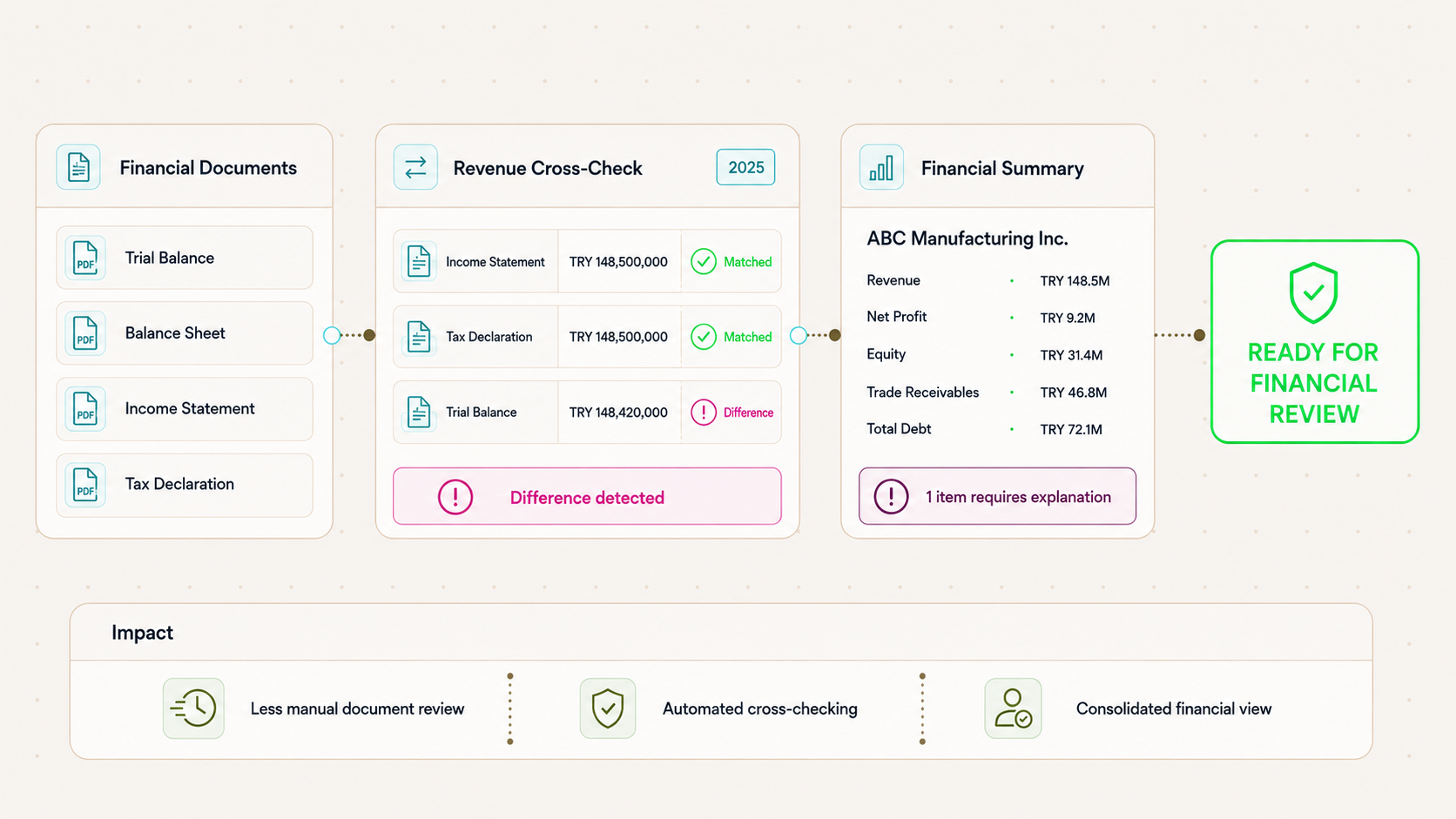
Revenue – 2025
Income Statement: TRY 148,500,000
Tax Declaration: TRY 148,500,000
Trial Balance: TRY 148,420,000
Result: Difference detected between the trial balance and other submitted documents.
The Agent can also identify cases such as:
- A financial figure appearing in one document but missing from another
- Different values reported for the same financial period
- Balance sheet figures that require further explanation
- Changes in profitability, debt, receivables, or equity that should be highlighted for review
Once the analysis is completed, the Agent consolidates the financial data and findings into a structured summary.
Customer: ABC Manufacturing Inc.
Revenue: TRY 148.5M
Net Profit: TRY 9.2M
Equity: TRY 31.4M
Trade Receivables: TRY 46.8M
Total Debt: TRY 72.1M
Key Findings:
- Revenue figures are largely consistent across submitted documents.
- A difference was identified between the trial balance and income statement.
- Trade receivables increased compared with the previous reporting period.
- One financial item requires additional explanation.
Result: READY FOR FINANCIAL REVIEW
The report is then presented to the relevant credit, risk, or operations team together with the supporting financial data and identified discrepancies.
Impact
Upsonic reduces the manual effort required to open multiple financial documents, extract figures separately, and compare the same financial items across different files.
By processing related documents together and highlighting inconsistencies automatically, the Agent helps factoring companies standardize financial document review and prepare customer assessments more efficiently.
Credit and risk teams receive a consolidated financial view with the relevant figures, discrepancies, and notable findings already organized for review, allowing them to focus on interpretation and decision-making rather than manual document processing.