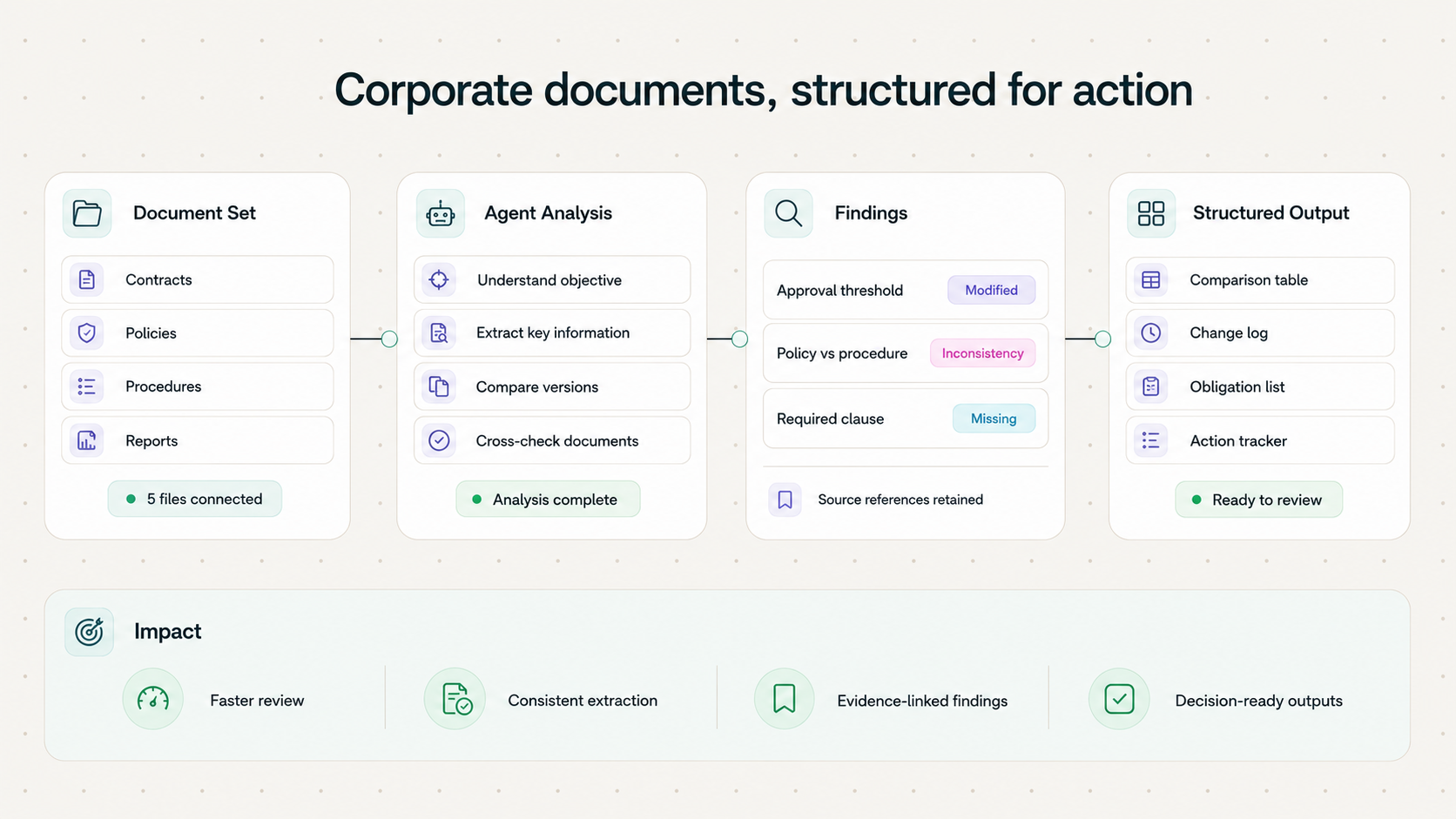
AI Agent Overview / Problem Definition
Upsonic helps enterprises analyze long and complex corporate documents, extract critical information, compare documents or versions, and transform the results into structured outputs that can be directly used by business teams.
The Agent understands both the document type and the user’s objective, then identifies relevant clauses, key data points, obligations, dates, risks, and required actions.
Instead of reading entire documents manually and transferring findings into separate spreadsheets or notes, employees receive a structured analysis tailored to the task they are trying to complete.
Capabilities
Document Understanding:
Analyzes reports, procedures, contracts, policies, and other corporate documents and identifies the sections and information relevant to the user’s request.
Structured Information Extraction:
Extracts key clauses, dates, obligations, entities, financial figures, responsibilities, actions, and other critical data into a structured format.
Document & Version Comparison:
Compares multiple documents or different versions of the same document and highlights added, removed, and modified content.
Multi-Document Analysis:
Analyzes multiple files together to identify common information, inconsistencies, missing items, or recurring patterns across the document set.
Output Generation:
Transforms findings into summaries, tables, checklists, comparison reports, or other institution-defined output formats.
Case Study
Traditional Workflow
Employees manually read lengthy reports, procedures, contracts, policies, and other corporate documents from beginning to end, highlight sections, take notes, and transfer information into spreadsheets or reporting templates.
If two versions need comparison they are often reviewed side by side, while multi-document tasks require the same information to be located and compared repeatedly.
Workflow with Upsonic AI
Documents: 3 policy documents + 2 procedure manuals
Objective: Identify approval requirements and operational responsibilities
Output: Structured comparison table
Document: Corporate Payment Procedure
Approval Limit: TRY 5,000,000
Responsible Team: Operations
Additional Approval: Treasury required above TRY 10,000,000
Effective Date: 1 July 2026
Previous Version: Approval required above TRY 5M
New Version: Approval required above TRY 3M
Change Type: Threshold modified
Impact: Additional transactions now require approval
Result: MATERIAL CHANGE DETECTED
Policy Document: Level 2 approval required above TRY 3M
Procedure Document: Level 2 approval required above TRY 5M
Result: INCONSISTENCY DETECTED
Action: Policy and procedure alignment required
The Agent can output executive summaries, structured data tables, clause comparisons, change logs, obligation lists, action trackers, compliance checklists, and management reports with source references.
Impact
Upsonic reduces the time employees spend reading, comparing, and manually transferring information from complex corporate documents.
Employees can focus on interpretation and decision-making while repetitive document review and information organization are handled automatically and consistently.