Overview
Upsonic enables payment institutions and banks to manage the chargeback process from the initial dispute reason to the final response package submitted to the bank.
The Agent analyzes the chargeback reason code, determines which evidence is required, collects and matches supporting documents from internal systems or merchants, identifies missing information, and prepares the response file in the format required by the relevant bank.
Capabilities
Dispute Analysis:
Reviews the chargeback reason code, dispute details, transaction information, and applicable requirements to determine what needs to be provided in response.
Evidence Collection:
Identifies the required supporting evidence and collects documents such as invoices, delivery records, transaction logs, and customer communications from internal systems or merchants.
Missing Document Management:
Detects missing evidence and requests the required documents from the relevant merchant or internal team before the response deadline.
Response File Preparation:
Organizes the collected evidence and prepares the chargeback response package according to the bank’s required structure and format.
Case Study
Traditional Workflow
In a traditional workflow, operations teams review incoming chargeback cases one by one.
For each dispute, employees first identify the reason code and determine which documents or transaction evidence are required.
Supporting information may be distributed across different internal systems or held by the merchant. Operations teams therefore need to manually search for transaction records, request invoices or delivery documents, follow up on missing evidence by email, and keep track of the case deadline.
Once all required information has been collected, the team manually prepares the response file according to the format and document requirements of the relevant bank.
This process requires repeated coordination across systems, merchants, and internal teams for every individual chargeback case.
Workflow with Upsonic
With Upsonic, the Agent analyzes the incoming chargeback notification and identifies the reason for the dispute.
It determines which evidence is required for the case and checks whether the necessary documents are already available.
Depending on the dispute, the Agent can collect and match information such as:
- Transaction records
- Invoices
- Delivery or proof-of-service documents
- Order information
- Payment records
- Customer communications
- Merchant-provided evidence
If any required evidence is missing, the Agent identifies the missing item and requests it from the relevant merchant or internal team.
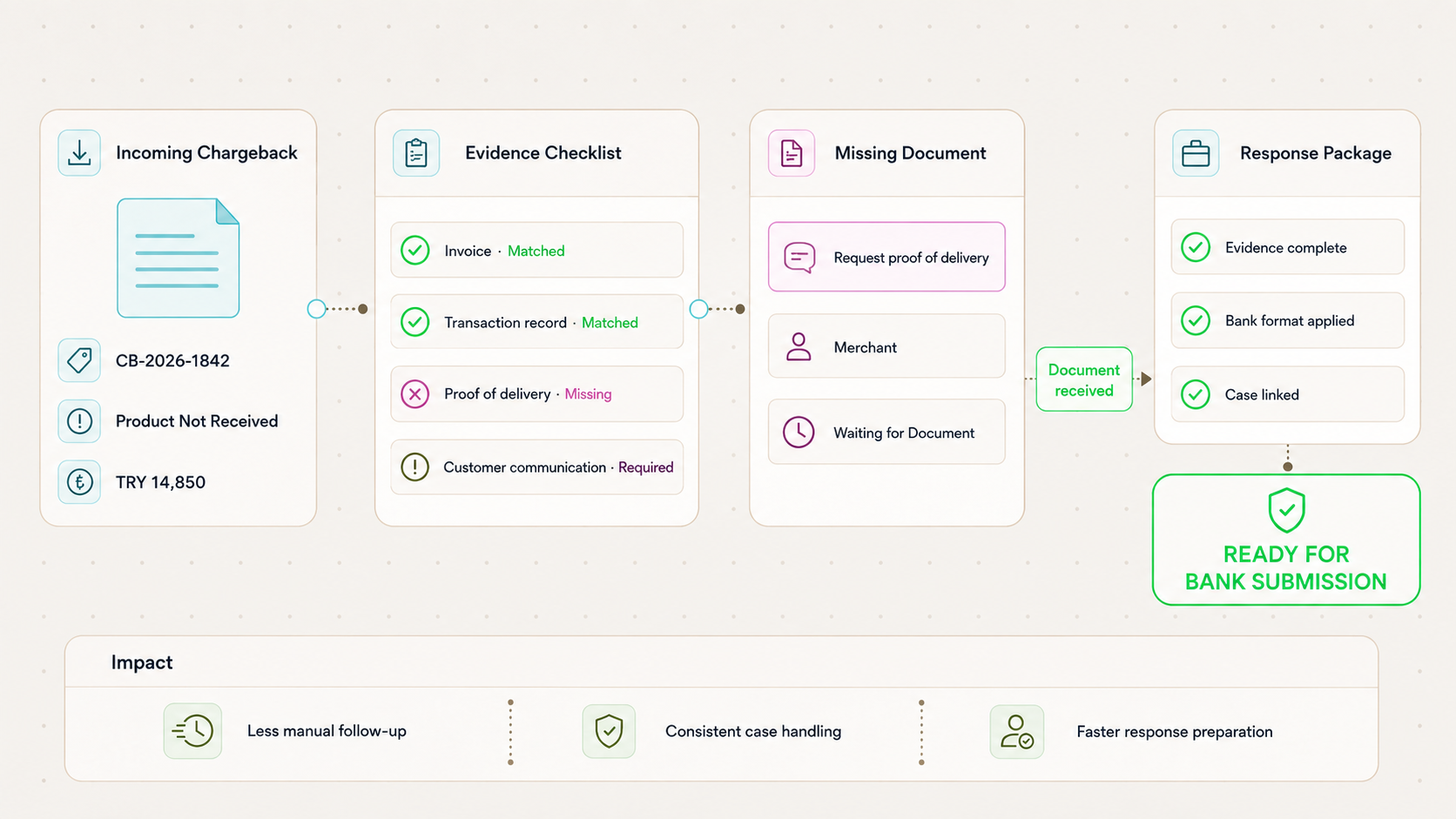
Chargeback Reason: Cardholder claims that the product was not received
Required Evidence: Delivery confirmation, invoice, transaction record, customer communication
Available Evidence: Invoice + transaction record
Missing Evidence: Proof of delivery
Action: Request proof of delivery from merchant
Status: Waiting for Document
Once the required evidence is completed, the Agent matches each document with the relevant dispute requirement and prepares the response package.
Chargeback Case: CB-2026-1842
Reason Code: Product Not Received
Transaction Amount: TRY 14,850
Evidence Collected: Complete
Missing Documents: None
Response Package: Ready
Result: READY FOR BANK SUBMISSION
The Agent structures the case according to the bank’s required format and presents the final response file to the operations team for review and submission.
Impact
Upsonic reduces the manual effort required to analyze chargeback cases, collect evidence, follow up on missing documents, and prepare bank-specific response files.
By managing the workflow from dispute analysis through evidence collection and response preparation, the Agent helps payment institutions and banks handle chargeback cases more consistently and reduce operational workload.
Operations teams can focus on exceptional or complex disputes while maintaining visibility into the reason code, required evidence, missing documents, case status, and final response package within a single workflow.